
Greater Houston Concrete Cutting
Precision concrete cutting, coring & selective demolition across Houston
Route slab sawing, core drilling, wall sawing, trenching and controlled-demolition requests to independent Houston contractors. The contractor confirms methods, availability, pricing and jobsite requirements.
- Commercial, industrial & GC-focused
- Dust-control requirements captured in scope
- Plan takeoffs & GPR scanning available
- Serving 40+ Greater Houston communities
Start a pricing request
Tell us the basics and we'll route your scope to the right crew.
Independent Contractors
Confirm credentials per project
Safety Requirements
Contractor-managed
Plan Takeoffs
From your drawings
GPR Scanning
Helps inform cut layout
Structured Intake
Clearer scope handoff
Project Estimates
Issued by the contractor
Start by project type
What are you trying to cut, core, or remove?
Pick the closest match to jump to the right scope. Not sure? Start a pricing request and we'll help you classify the work.
Openings in slabs & walls
Doorways, windows, HVAC and equipment penetrations.
Learn moreTrenching for utilities
Plumbing, electrical and drainage line trenches.
Learn moreCore holes & penetrations
Plumbing, conduit, anchor and testing cores.
Learn moreSelective demolition
Remove slabs, walls or structures in a controlled way.
Learn moreCore services
Concrete cutting & coring services
Specialized methods for every kind of cut, core and controlled removal.
Concrete Cutting Services in Houston
A complete guide to concrete cutting, sawing, coring and scanning methods — and how to pick the right one for your Houston slab, wall, or structural job.
Learn moreSlab Sawing (Flat Sawing) in Houston
Walk-behind slab sawing for floors, driveways, bridge decks and pavement — clean straight cuts to prep for removal, replacement, or new penetrations.
Learn moreWall Sawing in Houston
Track-mounted wall sawing for precise openings in vertical and inclined concrete — doorways, windows, HVAC penetrations and elevator shafts.
Learn moreConcrete Core Drilling in Houston
Diamond core drilling for clean round holes — plumbing, conduit, HVAC line sets, anchors, dowels and material sampling — in slabs, walls and foundations.
Learn moreWire Sawing in Houston
Diamond wire sawing for thick, heavily reinforced, or oddly shaped concrete — bridge piers, mass foundations and structural removals no blade can reach.
Learn moreTrench Cutting in Houston
Straight, parallel saw cuts that define clean trench edges in slabs and pavement for plumbing, electrical, and drainage runs before removal.
Learn moreSelective demolition
Concrete demolition & removal
Controlled, low-vibration removal that protects the structure you're keeping.
Concrete Slab Removal in Houston
Controlled removal of interior and exterior concrete slabs using saw-cutting, breaking, and clean haul-off — sized to your renovation, repair, or tenant build-out.
Learn moreFoundation & Footing Removal in Houston
Selective removal of concrete foundations, footings, and grade beams — cut, broken, and hauled off with attention to expansive clay soils and adjacent structures.
Learn moreInterior Selective Concrete Demolition in Houston
Cut-and-remove concrete work inside occupied and active buildings — openings, floor sections, and interior elements taken out with low noise, dust control, and clean haul paths.
Learn moreExterior Flatwork Demolition in Houston
Removal of sidewalks, driveways, aprons, patios, and parking-lot concrete — saw-cut clean, broken, and hauled off with attention to ADA edges and stormwater.
Learn moreStructural Concrete Removal in Houston
Engineered removal of load-bearing concrete — beams, columns, elevated decks, and shear walls — using wire and wall sawing to part heavy, reinforced elements safely.
Learn moreLoading Dock Removal in Houston
Removal and modification of loading-dock concrete — dock walls, pits, aprons, and leveler recesses — cut clean for reconfiguration, repair, or new equipment.
Learn moreHow it works
From scope to sawblade in four steps
A structured intake means the crew that arrives already understands your job.
- 01
Describe the work
Share the cut type, dimensions, location and access. Upload plans or photos if you have them.
- 02
We review the scope
We clarify depth, reinforcement, utilities and site constraints so contractors can assess whether scanning or other review is appropriate.
- 03
Get matched & priced
Your request is routed to an independent contractor who confirms qualifications, availability and a project-specific estimate.
- 04
Contractor performs the work
The performing contractor confirms methods, safety controls, slurry handling, cleanup and haul-off for the agreed scope.
Have drawings? Upload plans for a faster, more accurate scope.
Structural sheets, MEP drawings, or a marked-up photo all help us route the right crew and equipment the first time.
Choose the right method
Concrete cutting methods at a glance
Different cuts call for different tools. Here's how the core methods compare on typical use, depth and finish.
| Method | Best for | Typical depth | Finish |
|---|---|---|---|
| Flat / slab sawing | Floors, pavement, trenches | Up to ~24 in (multi-pass) | Straight horizontal cuts |
| Wall sawing | Vertical & inclined openings | Up to ~30 in | Precise square openings |
| Core drilling | Round penetrations | Depth varies by bit | Clean round holes |
| Wire sawing | Thick / heavily reinforced mass | Depends on access, routing & equipment | Large sections, tight access |
| Hand / ring sawing | Small openings, corners | Up to ~10 in | Flush & detail cuts |
Commercial & industrial
Built for GCs, facilities and industrial sites
From tenant build-outs and structured parking to industrial and water-treatment facilities, we route scope details to independent contractors. Scheduling windows, access, facility protocols and project-specific safety requirements are confirmed with the contractor performing the work.
- General contractor coordination & scheduling
- Facility & property-manager friendly access planning
- Industrial-grade equipment for reinforced concrete
- Documentation and site-safety expectations up front

Trade applications
Common concrete cutting applications
Real jobsite problems we help solve every week.
Doorway Openings in Concrete Walls
Cutting clean, square doorway openings through concrete and masonry walls without cracking the surrounding structure.
Learn moreWindow Openings in Concrete Walls
Precise window and glazing openings cut into concrete and masonry walls with straight, plumb edges ready to frame.
Learn moreHVAC Penetrations Through Concrete
Core holes and cut openings for ductwork, refrigerant lines, and mechanical equipment through slabs, decks, and walls.
Learn morePlumbing Penetrations Through Concrete
Core holes and slab openings for supply, waste, vent, and drain lines through slabs, foundations, and walls.
Learn moreElectrical Conduit Openings in Concrete
Cores, slots, and slab cuts for electrical conduit, feeders, and cable runs through slabs, walls, and decks.
Learn moreElevator Pit Cutting & Excavation
Cutting and removing slab and foundation concrete to form or deepen elevator pits in new and existing buildings.
Learn moreEquipment Pad Cutting & Removal
Cutting, coring, and removing concrete equipment pads and housekeeping pads for new or relocated machinery.
Learn moreTrench Drain Installation Cutting
Cutting slab channels for trench drains in warehouses, wash bays, kitchens, and process floors — to slope and to spec.
Learn moreSafety & silica
Respirable silica is managed, not ignored
Cutting and coring concrete can generate respirable crystalline silica regulated under OSHA 29 CFR 1926.1153. Project requirements can identify wet methods, HEPA extraction, containment and slurry management; the performing contractor is responsible for its exposure-control plan and compliance.
- Wet-cutting & water-fed blades to suppress dust
- HEPA vacuum & slurry containment where required
- Awareness of exposure control plans on regulated sites

Scan before you cut
GPR concrete scanning to locate what's hidden
Ground-penetrating radar locates rebar, post-tension cables, conduit and voids before the blade touches concrete. On post-tension slabs especially, scanning is the difference between a clean core and a very expensive mistake.
- Rebar & post-tension cable location
- Embedded conduit & utility detection
- Void and slab-thickness assessment

Serving Greater Houston
Concrete cutting coverage across the Houston metro. Find your city for local details.
Priority markets
Cypress
Cypress, TX concrete cutting for slab and wall sawing, core drilling, GPR scanning, and selective demolition in Harris County. Request pricing.
Learn moreHouston
Houston, TX concrete cutting for slab and wall sawing, core drilling, GPR scanning, and selective demolition in Harris County. Request pricing.
Learn moreKaty
Katy, TX concrete cutting for slab and wall sawing, core drilling, GPR scanning, and selective demolition in Harris County. Request pricing.
Learn moreRecent project types
A look at the kinds of concrete cutting and demolition work we scope.

Flat Slab Sawing
Walk-behind Husqvarna flat saw cutting a commercial parking lot slab in Houston.
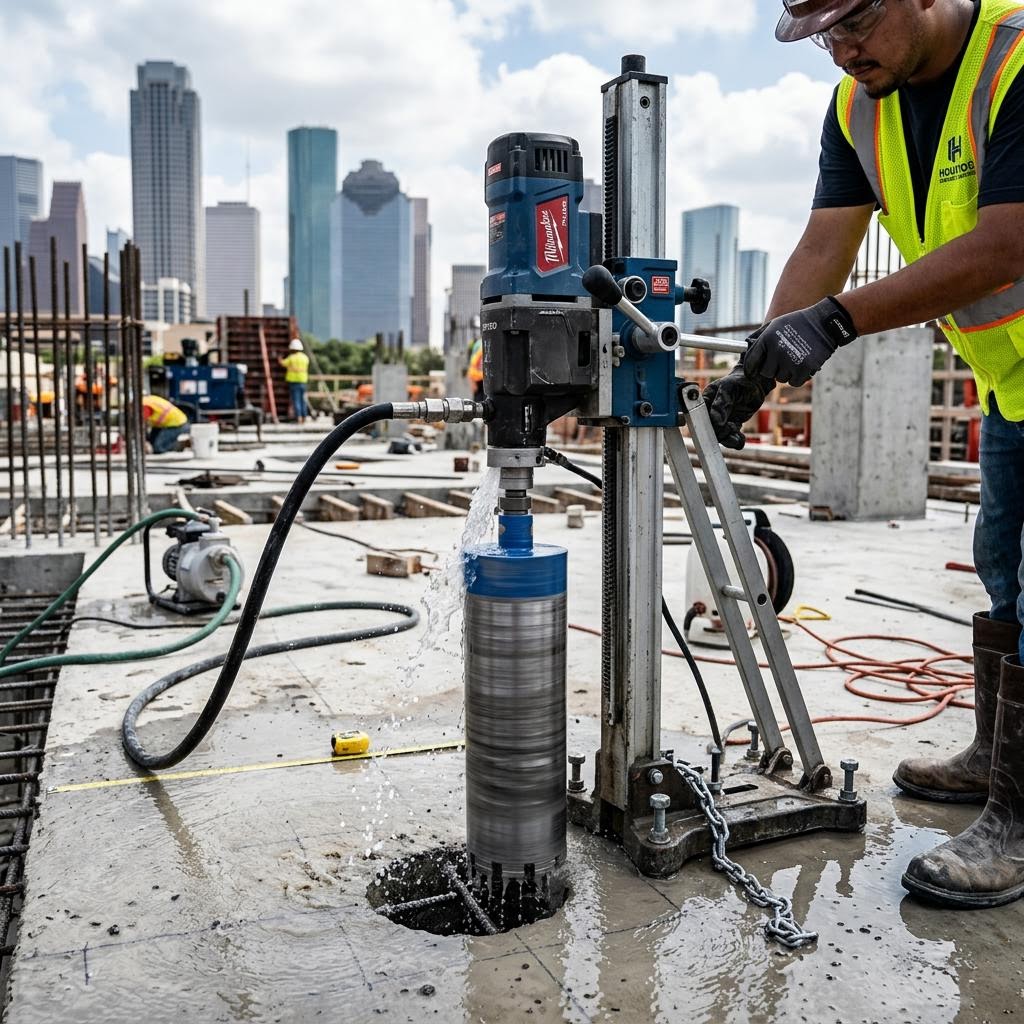
Diamond Core Drilling
Core drill producing a clean round penetration through a reinforced concrete floor.
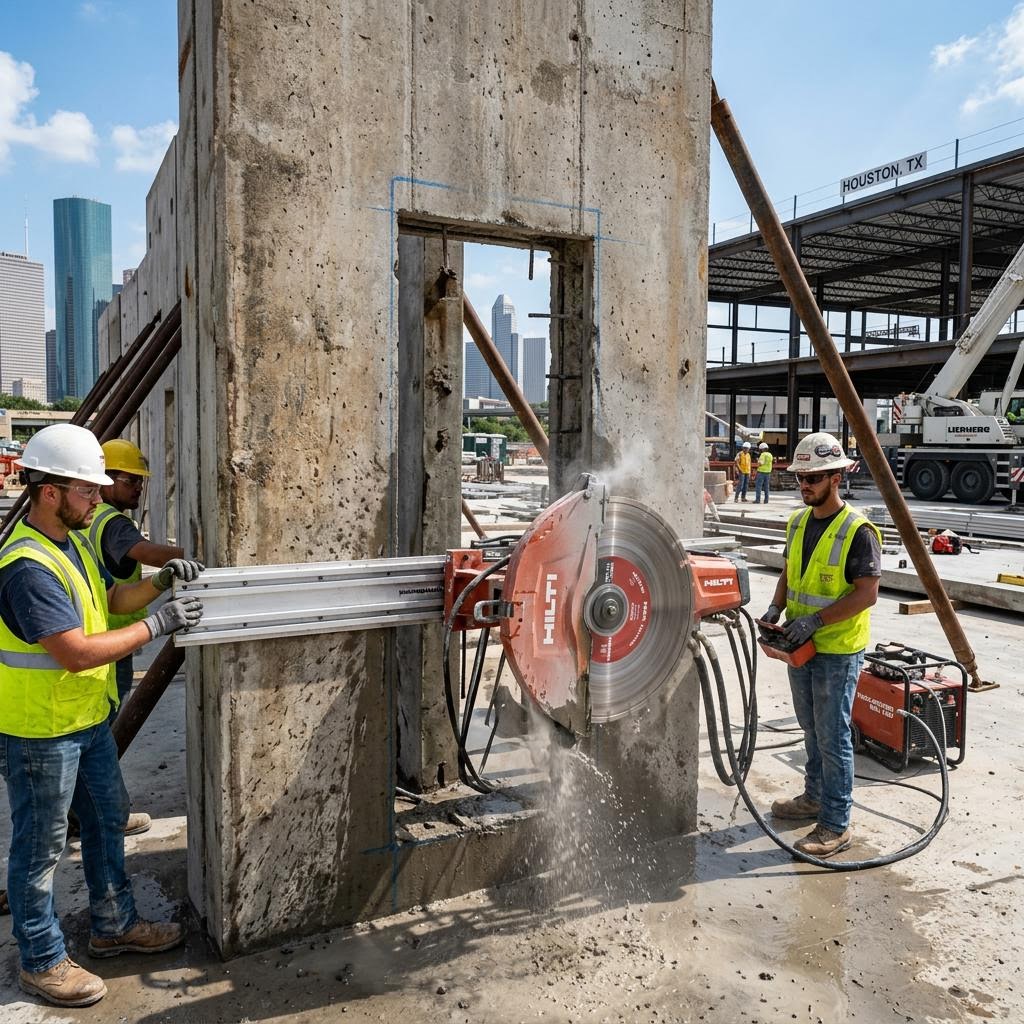
Wall Sawing – Doorway
Track-mounted wall saw cutting a full doorway opening through a tilt-wall panel.
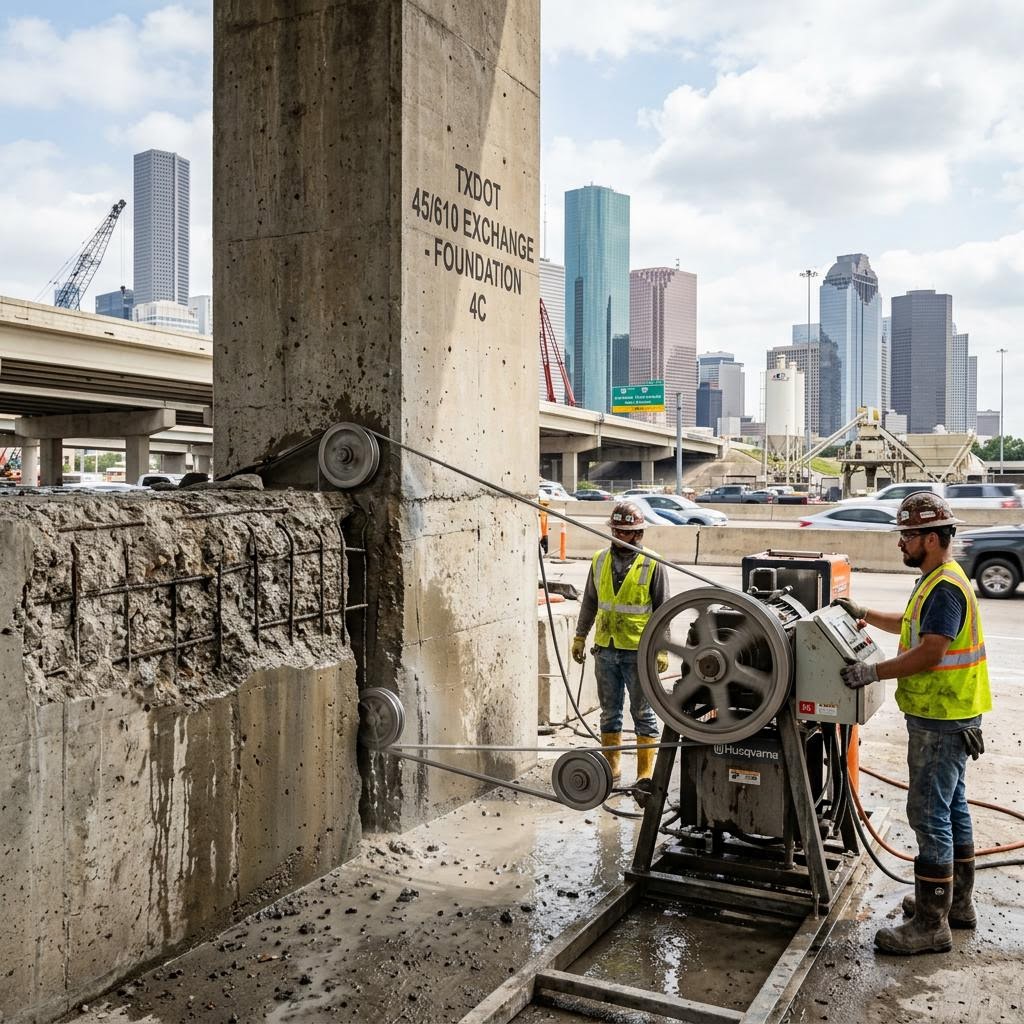
Wire Sawing
Wire saw removing a heavily reinforced foundation wall section with minimal vibration.
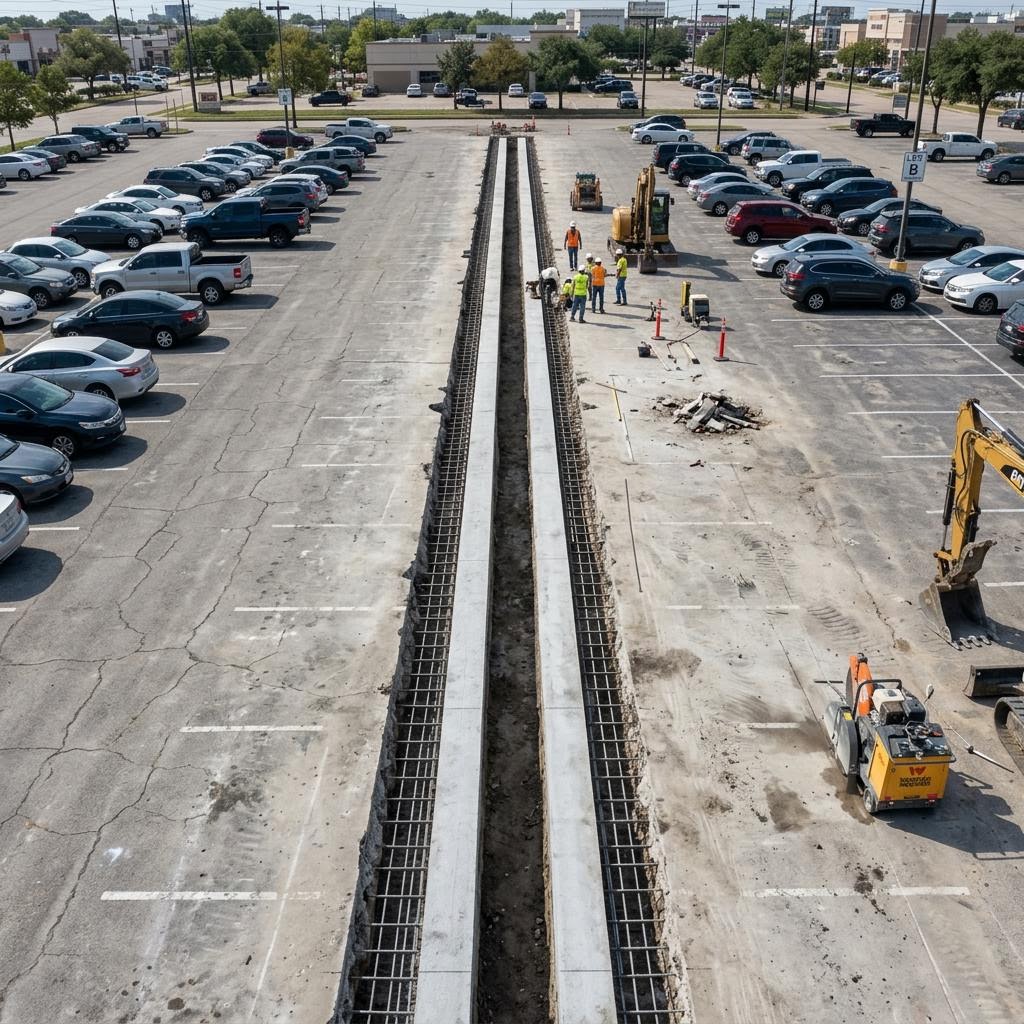
Utility Trench Cutting
Two precision parallel cuts through a parking lot slab for a new utility trench.

GPR Concrete Scanning
Ground-penetrating radar scan of a parking garage deck to map rebar before coring.
Questions
Concrete cutting FAQ
Quick answers to the questions we hear most.
- How thick a wall can a wall saw cut?
- Track saws commonly cut a foot or more from a single face, and cutting from both sides roughly doubles the reach. For very thick or heavily reinforced walls, wire sawing is the alternative.
- What size holes can be core drilled?
- Bit diameters commonly range from about one inch up to a foot or more. The rig is anchored or vacuum-mounted to keep the bore true, and holes can run vertical, horizontal, or angled.
- What is the difference between concrete cutting and demolition?
- Cutting is precise, controlled modification of cured concrete using diamond saws and drills, leaving clean edges and adjacent structure intact. Demolition removes concrete in bulk. Many jobs combine the two — cutting to define an opening, then removing the isolated section. See our concrete demolition hub for removal work.
- Is there a thickness limit for wire sawing?
- No practical one. Because the diamond wire forms a loop around the section, wire saws cut concrete of essentially any thickness — the limit is having room to route the wire and pulleys, not the concrete's size.
- What is the difference between slab sawing and flat sawing?
- They are the same thing — 'flat sawing' describes the horizontal orientation, and 'slab sawing' describes cutting a slab. Both use a walk-behind diamond saw that rides on the surface.
- Why saw-cut a trench instead of just breaking it?
- Saw cutting defines clean, square edges, which keeps the repair narrow, preserves the surrounding slab, and makes backfill and repour tidier. Breaking alone leaves ragged edges and risks overbreak into good concrete.
From the blog
Guides & insights
permits
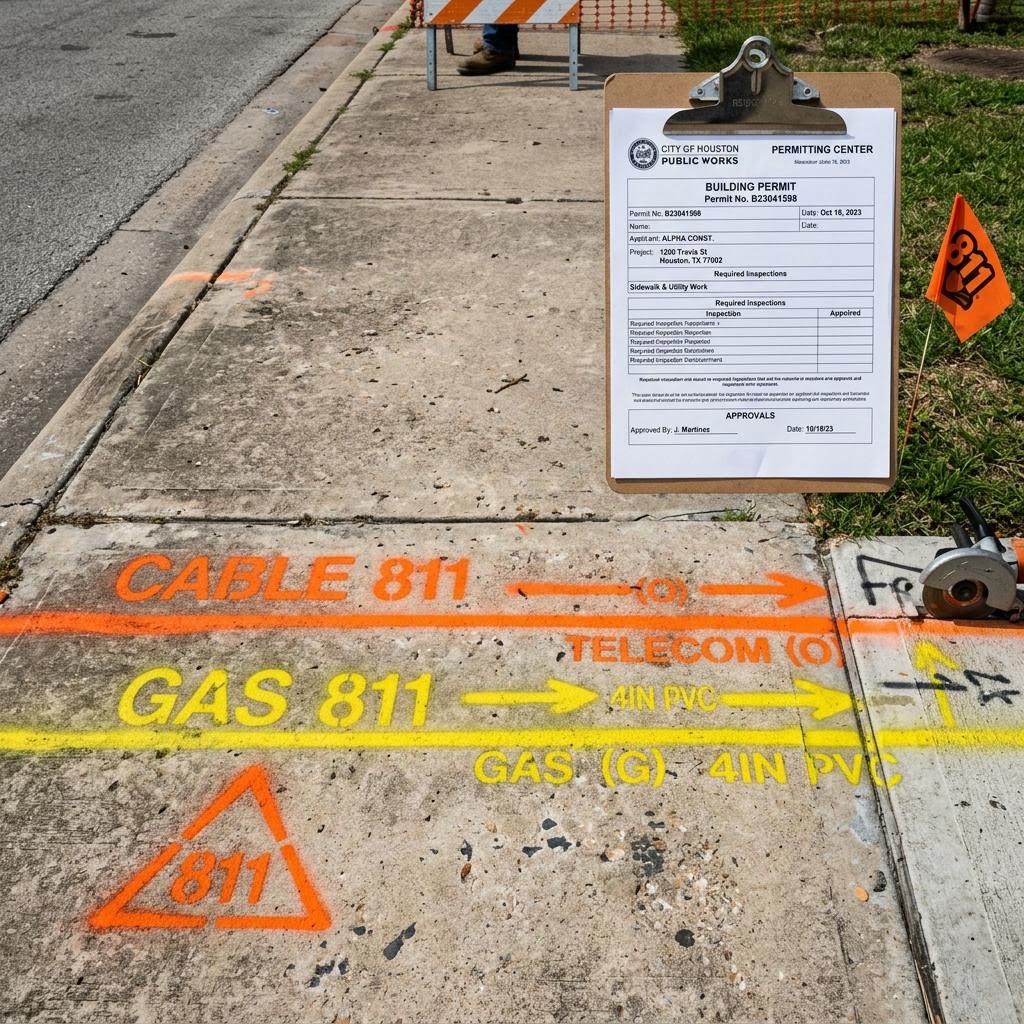
Permits and Utility Locates for Concrete Cutting in the Houston Area
Before a saw touches concrete, two questions come first: is a permit required, and have underground utilities been located? This guide explains Texas 811 one-call, when cutting work triggers permits, and how these fit a Houston project.
demolition
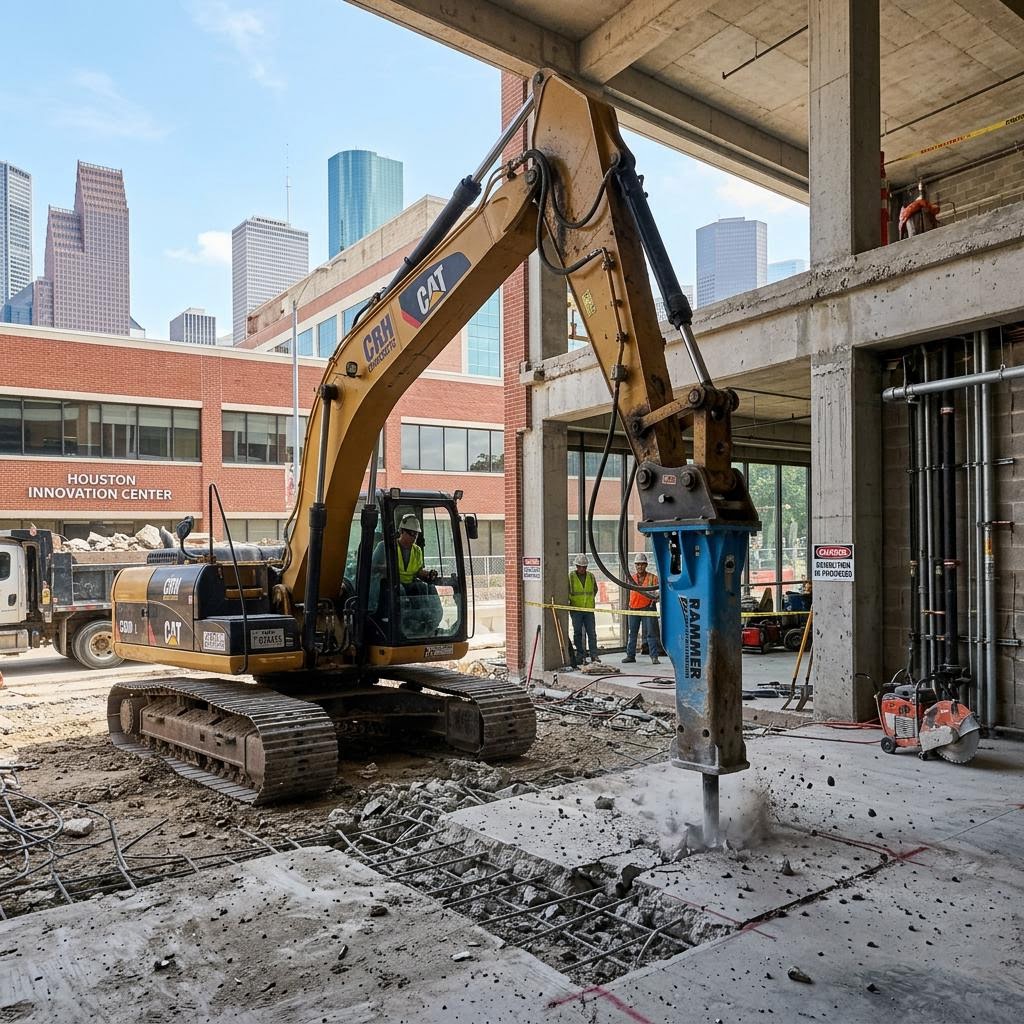
Planning Selective Concrete Demolition Without Wrecking the Rest
Selective demolition removes only what needs to go while protecting the structure, systems and finishes that stay. This guide covers how to plan a controlled concrete removal: scoping, structural review, cut-then-remove sequencing, dust and debris.
methods
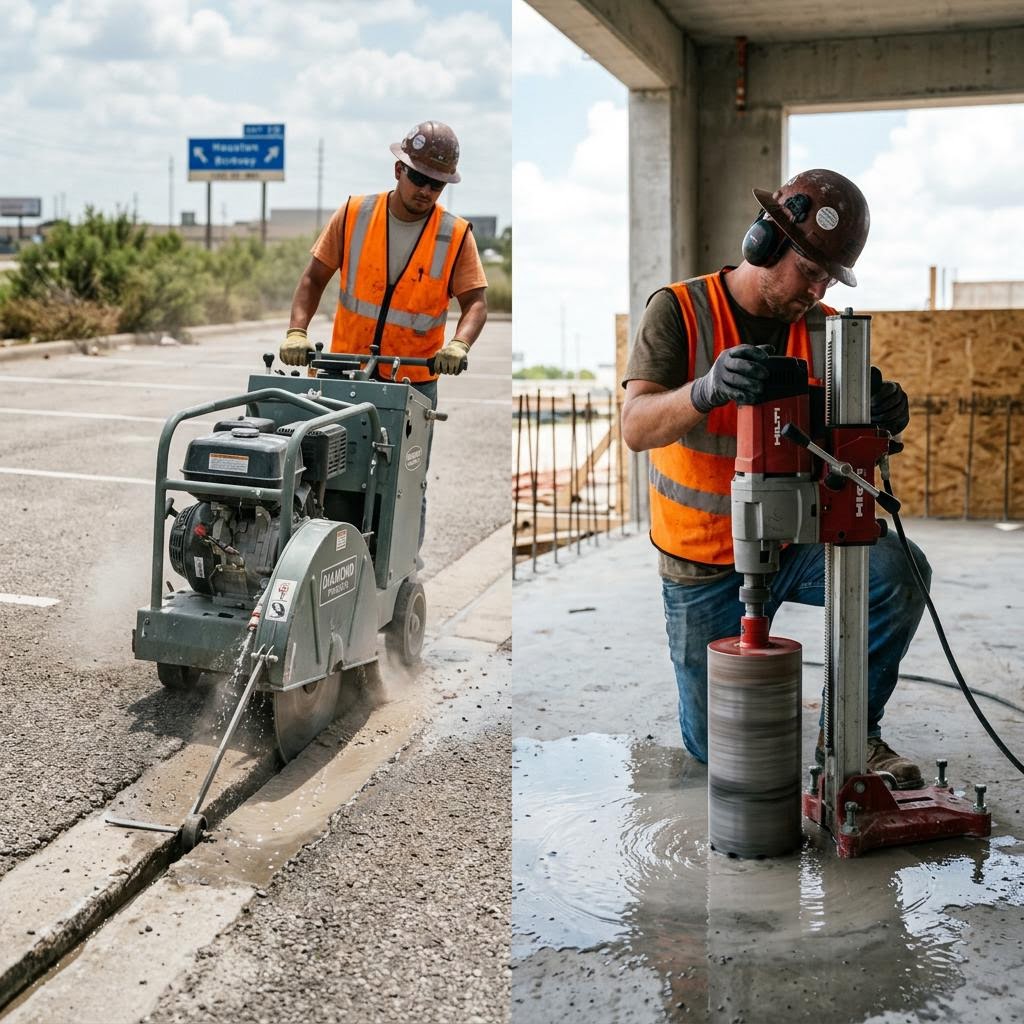
Slab Sawing vs. Core Drilling: When to Use Each
Slab sawing and core drilling are the two most-requested concrete cutting methods, and they answer completely different questions. This guide clarifies when a straight saw cut is right, when a round core is right, and when you need both.
Get honest concrete cutting pricing for your Houston project
Tell us what you need cut, cored or removed. We'll match you with a crew that can actually do it.